BYOD: Rules of Use
11 million takeover day is a scheme designed by the children’s commissioner and has run successfully at my school for the last three years. The idea is that children and young people get the chance to work with adults for the day, and be involved in the decision making process.
Each year we have tried to challenge a group of students to look at a subject, report their findings and explain their decision.
This year we have spent a lot of time purchasing, installing, configuring and testing equipment to allow students to bring their own devices into school to aid their learning. What we haven’t yet finalized is our policy.
I personally think it is very important to include the students in the policy writing process. Students must be able to understand the policy, and the reasons for it. This takeover day gave us the perfect opportunity to get the student view on our plans, and for them to decide on the rules of use. Ten boys and one girl were able to get involved today.
We discussed the type of mobile technology they had at home, and if they could think of ways of using it in the classroom. The students were paired off to work on presentations to be given to the group.
In both sessions, the students found many positive uses for mobile technology in lessons.
- Tablets are more up to date than textbooks
- Ebooks can’t have pages torn out or be scribbled on like books
- Ask google if the teacher is too busy to answer your question, or you are embarrassed to ask
- No need to book computers rooms which are few and far between
- Perfect for research and revision
- Text the teacher for help
- Video a demonstration by the teacher so you can watch it back later
- Typing can be faster than writing when making notes
- Students could adjust their device to their needs – Eg. someone with sight difficulties
The students in the second session also came up with some negatives
- Some students might use their devices for games or other distractions
- Some websites are not appropriate in school, some at not appropriate for children
- Not everything on the internet is true
I think they came up with some excellent points and ideas.
The second task was to create some rules, or a list of Do’s and Don’ts for our BYOD program. Group one came up with these.
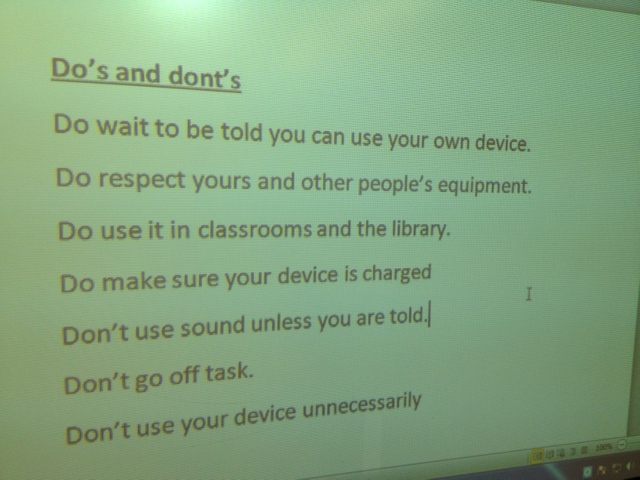
The second group came up with these.
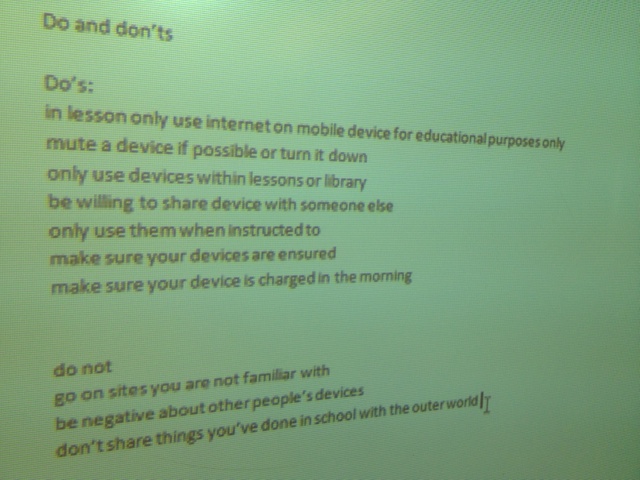
As you can see these two separate groups of students came up with very similar rules. Many of them we had thought about ourselves, but both groups came up with rules we hadn’t immediately thought of. The most interesting for me was “do not be negative about other peoples devices / do respect yours and other people’s equipment”. Both groups realized that some devices are more fashionable than others, and this shouldn’t be allowed to become a reason to taunt or bully. Both groups also wanted to include a rule about sharing the resources with those that don’t have one, or don’t want to bring in a device.
The whole process was really rewarding for me, and the feedback from the students was great. I think we need to get more students involved, especially more girls before we can finalize our policy.


Blog: BYOD – Rules of use. http://t.co/dKlZxQDl Students design their own policy. #BYOD #EdTech #TakeOver2012